
New Braunfels, Texas · Slab foundations
Slab Foundation Repair in New Braunfels, TX
Piers, a careful lift and a plan drawn for the ground under your house.
Slab foundation repair puts support back under the parts of a concrete slab that have dropped. Piers go down through the moving soil, and the slab is lifted back toward level and held there.
Tell us what you're seeing
- Free inspectionIt costs nothing
- No obligationStopping after the inspection is fine
- Town-by-town soil dataFrom the USDA soil survey
- You never pay usNo fee for using this site
- Call (830) 500-5898Or send the short form
If a crack has opened or a door has started to stick, you're far from alone in New Braunfels. About 69.3% of the city's homes were built in 1990 or later, and 40% of our USDA soil sample points landed on very high shrink-swell clay. That's a lot of young houses on ground that moves.
Signs a Slab Is Moving
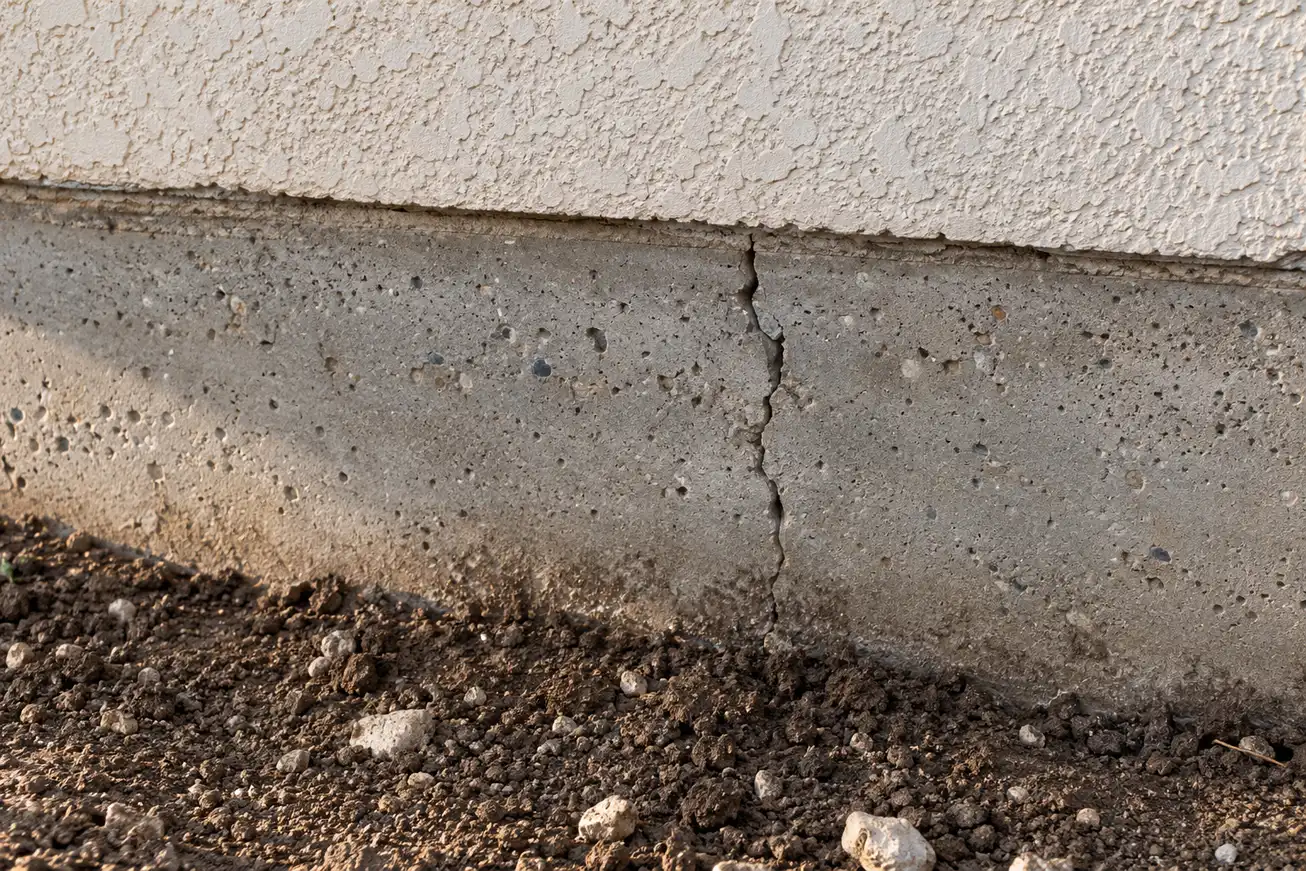
Plenty of cracks never need piers. The guidelines Texas engineers use say a crack on its own seldom weakens a foundation. What points toward a repair is a pattern, not one crack:
- Doors that drag at one top corner, or gaps that open above them
- Stair-step cracks in brick or stone that are wider at one end
- Cracks running at a diagonal from the corners of windows and doors
- Floors you can feel sloping, or tiles cracking in a line
- Cracks that come back after they've been patched
Size matters too. Under HUD's housing inspection standard, the line is a foundation crack at least 1/4-inch wide and 12 inches long. Floors have a yardstick as well. By the Texas guidelines, a tilt past 1% is usually noticeable, which works out to 1.2 inches over 10 feet.
What Slab Foundation Repair Involves
The repair comes in two parts: support, then lift. With pressed piles, each one is pushed down using the weight of the house until it stops moving down and the house starts to rise. The Foundation Performance Association says the final depth varies from pile to pile. The settled sections are then raised back toward their old height and shimmed right away, because a piling can spring back if it isn't.
Many slabs in New Braunfels are likely post-tension, with steel cables pulled tight inside the concrete. Concrete Network, a trade publication, warns that once a cable is cut, it's very hard to repair. So nobody should drill into the slab until they know where the cables run. Our post-tension slab guide shows how to tell if you have one.
Slab Foundation Repair on Clay and on Limestone
On the clay side, the ground keeps going. Under Branyon clay, the USDA survey finds a very high shrink-swell layer from about a foot down to past 6 feet, with no rock in the top 80 inches. Piers that stop short of the zone where soil moisture changes can keep settling, so depth is the whole game there.
On the limestone side, bedrock sits about 13 inches under Comfort soil and about 28 inches under Rumple. A house on rock has far less soil beneath it to shrink. If it's moving, look first for a plumbing leak or roof water pooling at one corner. Our guide to New Braunfels soil shows which side your lot is on.
What Slab Foundation Repair Costs
Published prices around New Braunfels vary a lot. One New Braunfels-area company lists $600 to $1,000 a pier installed. A national franchise's San Antonio office lists $1,500 to $3,000 for a steel pressed piling and $2,000 to $4,000 for a helical pier. If a crack turns out to be only cosmetic, the same office lists crack repair at $300 to $800.
The number of piers moves the total most. The Foundation Performance Association's spacing guide puts outside piers no more than 8 feet apart on a one-story house and 6 feet apart on a two-story brick house, with one at each corner. Our foundation repair cost guide works through why quotes vary.
Why Use Us for Slab Repair
We're a referral service, not a contractor. We pass your request to one independent foundation repair pro who serves your part of the area, and that pro does the inspection and any repair. The inspection is free, there's no obligation, and you never pay us. Any fee for the request comes from the pro, and our disclosure has the details. Our town pages add the local homework, from soil to permits.
From First Call to Final Floor Survey
1. Tell us what you're seeing. Call (830) 500-5898 or send the short form. Plain words are enough.
2. A free inspection. A local pro comes out. Ask for floor heights measured across the whole house, not just a look at the cracks. On clay, a second survey months later shows whether the floor is still changing.
3. A plan and a permit. In New Braunfels, a registered contractor pulls the permit, and the application needs a foundation plan that complies with chapter 4 of the 2021 International Residential Code.
4. Piers and the lift. The crew digs along the settled part of the slab, drives the piers and raises it.
5. Checking the work. After any lift, the Texas guidelines call for leak tests on the water and sewer lines under the slab, and a second floor survey to record where the house ended up.
Questions About Slab Foundation Repair
Should I patch the crack before the inspection?
No. HUD's inspection guide says a clean crack points to recent movement, so patching it first hides that clue. Mark both ends with a pencil and the date instead.
Will piers stop my slab from heaving up?
Not usually. The Foundation Performance Association, writing about the Houston area, says the repair piers most often used on homes there aren't tied to the slab's beams, so they can't stop the slab from rising when wet clay swells. Keeping the soil moisture even is what limits the heave.
Towns We Serve
From the clay around Converse to the rock near Canyon Lake, we also serve Seguin, San Marcos, Kyle, Garden Ridge, Schertz, Cibolo, Selma, Universal City and Live Oak. See all service areas.
Get a Free Slab Inspection in New Braunfels
Let us know what you've noticed, and we'll pass it to a foundation repair professional who works in your area. The visit is free, and saying no is always fine.
Tell us what you're seeing